MECHANICAL INNOVATION

A square case can be a powerful frame. In the Monaco Evergraph, TAG Heuer uses that frame to show the machinery rather than conceal it. The result is a watch whose technical proposition is visible before its specifications are read.
Presented at Watches and Wonders in April 2026, the Evergraph introduces calibre TH80-00, developed with Vaucher Manufacture Fleurier. TAG Heuer engineered the compliant chronograph mechanism: flexible components perform work that would traditionally involve pivoting parts.
Flexibility as an engineering idea
The important word is compliant. In this context, it describes parts designed to deform in a controlled way. TAG Heuer says the architecture reduces friction, wear and lubrication requirements. Those are the manufacturer’s engineering claims, rather than conclusions from a long-term test by Superwatchman.
For the collector, the more interesting question is how that idea translates into experience. A chronograph is something people operate. Its appeal includes the movement of the pushers, the start of the seconds hand and the return to zero. Innovation in the mechanism should eventually be judged through that whole sequence, not only through a diagram.
A square that earns its place
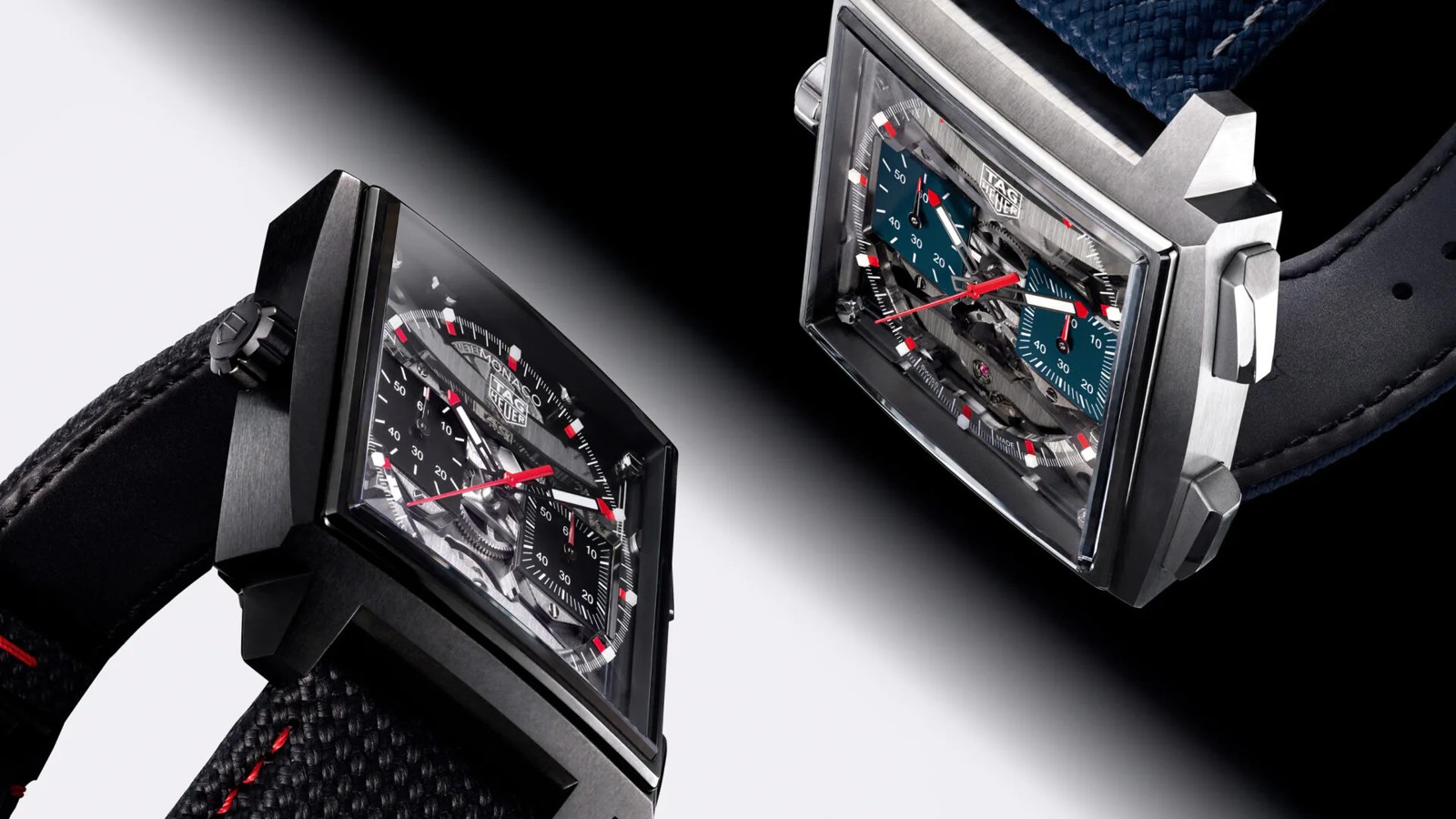
The 40 mm case is grade 5 titanium. A translucent dial exposes the movement’s angular structure, while the elongated pushers reinforce the case’s horizontal lines. Inside, the TH-Carbonspring oscillator runs at 5 Hz.
Visually, the case and movement appear to belong to the same argument. There is less sense of a circular mechanism merely being dressed in an unconventional shell. The open architecture gives the square interior something purposeful to contain, with the chronograph displays providing recognisable points of reference.
That does not make openness an automatic virtue. A watch can reveal so much that the time becomes difficult to find. In the Evergraph’s official images, the contrast between the indications and the surrounding structure is therefore the detail worth studying. Transparency is most persuasive when it leaves the hierarchy intact.
Look beyond the launch vocabulary
New mechanisms tend to arrive accompanied by large claims. Our interest here is narrower and more concrete: a familiar watch shape has been used to make a different mechanical approach visible. That gives the Evergraph a reason to exist beyond a new colour or a commemorative inscription.
A prospective owner should still spend time with it on the wrist. Square dimensions do not translate directly into the wearing impression of a round watch. The corners, the strap’s departure from the case and the thickness all contribute to the silhouette.
A convincing direction
We find the Evergraph strongest when treated as an exploration of how a chronograph can be built and presented. Its visual complexity follows a technical decision. Whether that makes it the right Monaco for a particular collector will depend on the pleasure of using it, but the underlying design question is a worthwhile one.
Source and photography: TAG Heuer — official announcement and specifications. Images © TAG Heuer. This article is editorial analysis of official photography and published specifications, not a hands-on review.